Grass-roots officers and men in a warehouse in Guangzhou Military Region have no worries.

  
The People’s Liberation Army newspaper Guilin, September 26th, Cao Chunxin and Li Pusong reported that in late September, a working group of a branch of the Joint Logistics Department of Guangzhou Military Region went to an ordnance warehouse for investigation. Originally, they wanted to hear about the problems that needed to be solved by the higher authorities. Unexpectedly, the officers and men didn’t put forward one, and all the problems were solved by the initiative of the warehouse party Committee. Mo Bingan, director of the warehouse, told the author that it is important to do good things, do practical things and solve difficult problems for officers and men, and take the initiative.
Because the warehouse is located in a remote ravine, the families of cadres and non-commissioned officers face many difficulties in obtaining employment and their children going to school. In recent years, these "worries" have caused some cadres to be distracted in their work to varying degrees. These issues were put on the agenda of the warehouse party committee. After many visits to the resident party and government leaders and consultations with relevant departments, they arranged jobs for seven dependents. The "gloomy clouds" of cadres have dispersed, and they are more motivated to work. Not long ago, sergeant Feng Zhenhua’s mother was seriously injured in a car accident. The warehouse launched a love activity for her comrades, helped solve the medical expenses, and sent people to express condolences to the local authorities to coordinate and solve the matter. Feng Zhenhua’s family was deeply moved.
Listen attentively to the voices of officers and men, and pay attention to the warmth and coldness of officers and men. The warehouse seized the opportunity of infrastructure construction, and included the improvement of drinking water for officers and men in the warehouse as a necessary project, raising hundreds of thousands of yuan to purchase modern drinking water purification equipment, so that officers and men drank clean and sweet drinking water. They also built bathhouses for two sub-warehouses, and purchased a solar hot water system for each post, so officers and men no longer have to worry about bathing.

Editor: Cao Jin

Directly hit the villagers in the tornado-stricken village of Funing, Jiangsu Province, painful memories of the moment of shock.

Directly hit the villagers in the tornado-stricken village of Funing, Jiangsu Province, painful memories of the moment of shock.

  Zhongxin. com, Nanjing, June 23 (Gu Hua Gu Ming Screen) At about 2 pm on June 23, a rare tornado occurred in Wutan Lixin Village, Funing County, Yancheng City, Jiangsu Province. Within half an hour, this small village fell into darkness, trees fell down, chickens flew and dogs jumped, and villagers fled everywhere. Many casualties occurred. The reporter from Zhongxin. com rushed to Lixin Village at 5: 30. The wind had stopped, and the whole village was in ruins. People gathered around their completely destroyed homes.

  Lixin Village is located on the side of National Highway 204 in Funing County. A small river divides the village into two settlements, north and south. There are more than a dozen families on both sides of the river. After the gale, none of them are intact, some are completely collapsed, and some have skylights on their roofs, although the walls are still there.

  Xia Zhengmei, a 62-year-old villager, recalled that when it was windy, she and her wife were both in the house, and they were at a loss for a while, thinking that they could avoid the limelight by hiding in the house. Unexpectedly, the roof was lifted in an instant, and the solar water heater on the roof made a loud noise. They hurriedly rushed out of the house.

  In the afternoon, villager Chen Fengling visited her neighbor Wang Weiying’s house. When they were talking outside, the wind was strong. Wang Weiying said that she would close the window in the house. Just as Chen Fengling watched her rush into the house, unfortunately, Wang Weiying’s house was swept down by the wind, and Wang Weiying was no longer seen in a pile of bricks and rubble. By the time the villagers pulled out Wang Weiying, she was out of breath.

Directly hit the villagers in the tornado-stricken village of Funing, Jiangsu Province, painful memories of the moment of shock.

  Dong Haiyun, who is in her fifties, just returned to her home in Lixin Village from Yancheng that afternoon. Half an hour later, the wind was strong, and before she could run out of the house, the house collapsed. After receiving the notice from the neighbors, her family came to pull her out and died.

  "It’s dark outside, and people who are blown by the wind can’t open their eyes." Tang Yuzhong, a villager from the fifth group of Lixin Village, said that he and his wife were in the house when there was a strong wind. They opened the door together and planned to rush out of the house. However, the door could not be opened because it was resisted by the wind. In a hurry, he knocked down the door and took his wife to the front yard. They each hugged a tree stump before insisting that the wind stopped. "My son and nephew are both injured. They have gone to the hospital for treatment." Tang Yuzhong said.

  "More than 200 ginkgo trees have all been destroyed." Chen Zhong, a young man, stood beside the ginkgo forest of his uncle’s house, anxious and at a loss. According to him, his uncle doesn’t live in his hometown, and there are more than 200 ginkgo trees at home, which he usually entrusts to him. In the gale that afternoon, more than 200 ginkgo trees were all broken, and the ground was covered with blue fruits. Chen Zhong said that some of these ginkgo trees have been growing for 27 or 8 years, and the thickest trees are more than 30 centimeters in diameter and worth more than 10,000 yuan. "So many ginkgo trees add up, and the economic loss is about 200,000 yuan."

  "Old mother shouldn’t be left in the house … …” Villager Zhang Changming wept bitterly. He said that when it was windy, he was in the East Room and his 84-year-old mother was in the Westinghouse. At the moment when the house was shaking, he wanted to rush into the Westinghouse to save his mother, but he was pinned down by the roof beam of the suddenly collapsed house. When he climbed out and ran to the Westinghouse, he even called his mother but there was no response. Finally, with the help of relatives and friends, he dug up his mother’s body.

  Zhang Bilong, a villager, said that he was lucky. When it was windy, he was driving a small truck home. When he got home, he was hit by a tornado, and the car was blown straight into the river. Just as he quickly opened the door and jumped into the water, a big tree was blown up by the wind and pressed against the truck in the river.

  According to the villagers, most local young people go out to work and study, and those who stay in their hometown are basically old people. Old houses and old people, in such bad weather, tragedy happened. (End)

COVID-19’s mortality rate remains low. What are the reasons for Germany’s better anti-epidemic performance?

  Reference message networkReported on April 16According to an article published in the Nihon Keizai Shimbun on April 15th, in the context of the spread of the COVID-19 epidemic, there were more than 20,000 deaths in COVID-19, Italy, while there were only over 3,000 deaths in Germany. Obviously, the mortality rate in Germany is low. So what is the reason why Germany and Italy have different performances in this epidemic and the mortality gap is huge? This paper analyzes this, and the specific content is compiled as follows:

  A document from Germany made an in-depth analysis. The document points out that Germany’s good anti-epidemic performance lies not only in its sound medical system, but also in its lifestyle with German characteristics.

  Make a good plan in advance: "In order to slow down the infection rate, schools can only be suspended and large-scale gatherings are prohibited. Electricity and natural gas can be supplied normally, but aviation and railways are out of service, hospitals are full, and it is difficult to purchase disinfectant and masks. It will take three years for the epidemic to subside. "

  The content of the document seems to be an analysis of the epidemic situation in COVID-19, but in fact it is the content of the report drafted by the German Federal Parliament seven years ago, that is, in January 2013. If there is a world-scale virus infection, what impact will it have on Germany and what should the government do? The report gives a detailed analysis of the possible epidemic in more than 30 pages, as if it were a prediction of the current epidemic in COVID-19.

  Push to work from homeIn March this year, the German government issued a directive to restrict going out, and the whole country took action. For example, the Bundesbank quickly switched to the home office mode. Central bank executives use computers to monitor the market and buy and sell bonds at home. Attendance is limited to employees who maintain a stable cash flow. President Jens Weidemann only shows up once a week.

  A person concerned revealed: "If nothing is prepared, it is impossible to work from home smoothly. The Federal Bank has made arrangements in advance so that employees can operate on home computers. " According to the experience of dealing with the outbreak of acute respiratory syndrome (SARS) in 2002-2003, the Bundesbank is ready to deal with "in case".

  German newspapers and publishing circles basically work from home. Germany attaches importance to the balance between work and life, and few people criticize working from home. According to the statistics of the German Public Broadcasting Union, 90% of the people agree with "contact restriction" measures such as restricting going out.

  The medical system is soundA sound medical system is also conducive to helping patients recover. According to the statistics of the Organization for Economic Cooperation and Development, the number of beds in the intensive care unit in Germany is about 34 beds per 100,000 population, which is four times that of Italy. Ventilator manufacturers such as Doelger are German enterprises, and it is easier for the government to ask them to increase production. Germany has spare capacity to increase testing in order to find infected people as soon as possible.

  Have a different lifestyle.Another factor that cannot be ignored is that the lifestyle of the German people is conducive to preventing intra-family infection.

  The proportion of people over 65 in EU member states is about 20%, and there is not much difference. But the lifestyle of the elderly is very different.

  In Germany, children are independent at an early age and usually do not live with their elderly parents. However, it is not uncommon for adult children to live with their parents in southern Europe. Many people in the medical field said: "It is easier for Germany to isolate elderly people with high risk of infection than Italy."

  Spacious living environmentMild patients usually rest at home. German families are spacious, and most of them have guest rooms. Even if family members live together, it is easier to isolate them at home. According to data released by the German Federal Statistical Office on the 7th, about 7% of people are inconvenient to be isolated at home because of the "narrow" housing. In line with the definition of "small", the bedroom and living room are the same room, or there is no separate room for adult children. The average proportion of EU member States is 16%, and that of Italy is 28%.

  This has a certain historical origin. After World War II, housing construction became the main content of government policy. Germany has created a good living environment, paying attention not only to quantity but also to quality, which has played a role in fighting the COVID-19 epidemic.

  National "uneasy" securityThe word "German Angst" is used to describe the social characteristics of Germany, which means that Germans are easy to worry about the future and will be prepared for emergencies.

  In the COVID-19 outbreak, the Germans also envisaged the "worst case". German Chancellor Angela Merkel said that 60% to 70% of the people may be infected with COVID-19. Even if the situation is not ideal, if it is true, tell it frankly and avoid risks as soon as possible. German nationalism seems to have played a role in fighting the epidemic at present.

  On April 11, in Berlin, Germany, people kept a distance when resting on benches. Xinhua news agency

China’s capital market has broad long-term investment prospects, and more global investors have increased their investment.

  CCTV News:Compared with the policies of the Federal Reserve from last year to this year, the People’s Bank of China has always maintained a firm policy, a prudent monetary policy is flexible, moderate, accurate and effective, and has continuously increased its support for the real economy. China’s economy continues to stabilize and improve, which also makes foreign investors continue to be optimistic about China’s development and invest more in RMB assets.

  Recently, Goldman Sachs said that considering the rapid recovery of China’s domestic personnel mobility and the strong economic activity data in the first two months, the forecast of China’s GDP growth rate in the first quarter and the whole year will be raised to 4.0% and 6.0% respectively from the previous 2.7% and 5.5%.

  At the same time, BlackRock think tank and other institutions have also upgraded China’s stock rating. The northbound capital, regarded as the "A-share weathervane of international capital allocation", has accumulated a net inflow of more than 170 billion yuan this year, exceeding the level of last year, conveying the confidence of global investors in China’s economic prospects and the performance of RMB assets.

  Wen Bin, Chief Economist of China Minsheng Bank:With the recovery of China’s economic growth momentum and the further opening of the financial market, the investment and hedging properties of RMB assets have gradually become prominent. Since the beginning of this year, the net inflow rate of northbound funds has obviously accelerated compared with last year. In addition, in terms of direct investment, the actual use of foreign capital has also maintained a positive growth. Taken together, all these indicate that China’s economy continues to maintain a long-term positive trend, and RMB assets are still highly attractive to global investors.

  Many professional investment institutions said that in the medium and long term, China’s capital market has broad long-term investment prospects, which will attract more global investors to invest more in China. This will also make the proportion of RMB assets in global allocation match China’s position in the global economy in the future.

  Tobias, Global CEO of Allianz Investment:China is the second largest economy in the world with a population of 1.4 billion, and it is expected to become the second largest onshore asset management market in the world. In the future, we hope to make our own contribution to the continuous opening of China’s capital market and support China’s economic development through our extensive active investment solutions.

CCTV: "Nuclear fog dyeing" is a lie packaged with pseudoscientific concepts.

  Original title: Why is "nuclear smog" a rumor?

  June 5th is World Environmental Protection Day. At the Beijing Green Communication Conference held a few days ago, the Beijing Municipal Environmental Protection Bureau released the "Top Ten Environmental Protection Rumors" for the first time, among which the second rumor was: "The smog persists because of nuclear pollution", also known as nuclear smog. The core point of an online article entitled "The Collapse of China’s Coal Industry and Nuclear Haze Disaster" is that some thermal power plants in northern China use coal containing radioactive uranium from Inner Mongolia, and uranium is discharged into the air in the form of dust with the coal burning, resulting in nuclear radiation pollution, which is related to the frequent smog phenomenon in North China in recent years. Under the guise of science, the article quotes a lot of false data and false facts, which makes the article very deceptive. For friends who don’t know the truth and lack scientific knowledge, it is easy to be deceived. (Why is "Nuclear Haze" in Focus Interview 20160605 a rumor?)

  Cctv news(Focus Interview): Today is June 5th, which is World Environmental Protection Day. At the Beijing Green Communication Conference held a few days ago, the Beijing Municipal Environmental Protection Bureau released the "Top Ten Environmental Protection Rumors" for the first time, among which the second rumor was: "The smog persists because of nuclear pollution", also known as nuclear smog. So how did this statement of nuclear smog come from? We put the time back to last winter. After the winter, because of the continuous smog weather, many places in China started the red warning of heavy air pollution for the first time. Just as everyone is asking how the smog is produced, where it comes from and why it is difficult to eliminate it, an online article about "nuclear fog dyeing" has attracted attention.

  First look at the title of this article: "China’s coal industry collapse and nuclear fog disaster." Nuclear, smog, pollution, disaster, every word is very "lethal". The Ministry of Environmental Protection also specifically clarified that there is no correlation between nuclear radiation and smog formation. So, what is this "nuclear fog dyeing" that has caused many speculations?

  The core point of this online article entitled "China’s Coal Industry Collapse and Nuclear Haze Disaster" is that some thermal power plants in northern China use coal containing radioactive uranium from Inner Mongolia, and uranium is discharged into the air in the form of dust with coal combustion, which causes nuclear radiation pollution. In recent years, frequent smog phenomena in North China are related to this. At the same time, the article also puts forward in horror that this kind of nuclear radiation pollution will seriously affect the ecology, and the disaster far exceeds the Iraq war that year. As soon as this statement came out, it caused a lot of hot discussions on the Internet.

  In response to the statement of "nuclear fog pollution", the Ministry of Environmental Protection gave an authoritative conclusion at the beginning of this year: the radioactive level of China’s atmospheric environment has been stable for more than ten years, and no particulate matter with high uranium content has been found. Nuclear radiation has nothing to do with the formation of smog. The conclusion is very clear. So, how did you get this result?

  According to the Radiation Environmental Monitoring Technology Center of the Ministry of Environmental Protection, since 2006, according to the population density and geographical conditions, China has established 167 air level monitoring stations in various places. These monitoring stations are distributed in densely populated areas of large and medium-sized cities, and the density of distribution is close to the level of nuclear powers in the world. The news of these monitoring stations will be transmitted to the National Radiation Environmental Monitoring Data Center.

  Relevant personnel of the Radiation Environmental Technology Monitoring Center of the Ministry of Environmental Protection stressed that since the saying of "nuclear fog dyeing" began in 2014, the monitoring of uranium content in the air has been particularly strengthened. Automatic monitoring and laboratory analysis show that the data is normal.

  Ten years of automatic detection and laboratory analysis have not found any abnormality in the radioactive level in the air in China, which is the conclusion of the Ministry of Environmental Protection. The reporter specially went to two other scientific research institutions for interviews, one is the China Institute of Atomic Energy, which is called the "incubator" of China’s nuclear industry, and the other is lasg.

  Liu Senlin, vice president of China Institute of Atomic Energy, said: "We began to monitor the uranium content in the air around 1958, and it has accumulated for almost 60 years. From the level of our laboratory, we can probably find 0.1 millibecquerel in the air. Uranium in every cubic meter of air can’t be measured most of the time, even if the measured value is very small, it has no impact on the human body." Wang Yuesi, a researcher in lasg, said: "There are 36 observation stations in all parts of the country, which have been observed since 2012. According to the extensive observation data in the country, uranium in atmospheric particles in our country is radioactive, including other radioactive elements. There is no abnormality and no change, so everyone can rest assured."

  The data from the Radiation Environmental Monitoring Technology Center of the Ministry of Environmental Protection, China Institute of Atomic Energy and lasg all show that the atmospheric environmental radiation level in China has been stable for more than ten years, that is to say, the so-called "nuclear fog pollution" does not exist at all.

  At the same time, I would also like to remind everyone that the monitoring results of radiation levels in the air are regularly published on the official website of the Ministry of Environmental Protection and the official WeChat meeting of the National Nuclear Safety Administration. You can check them from time to time if you are worried.

  Go back and have a look at the ins and outs of this article. The source of the so-called "nuclear fog dyeing" mentioned in this article: coal with uranium from Ordos region of Inner Mongolia. If you want to say what uranium is, you may first think of the atomic bomb. Yes, highly enriched uranium can make nuclear weapons. Then, is there uranium in the coal in Ordos, Inner Mongolia? Is the coal there the so-called "uranium coal" that will cause nuclear pollution? Let’s listen to the authoritative experts.

  Pan Ziqiang, an academician of China Academy of Engineering, said: "The content of coal and uranium in Inner Mongolia should be low in the whole country." Liu Senlin said: "We have measured more than 90% of the coal mines in Inner Mongolia. According to the average output, the content of coal in Inner Mongolia is 49.8 becquerels per kilogram, and the national value is about 61 points. Therefore, the uranium content in coal mines in Inner Mongolia is lower than that in the whole country. The coal in our country is equivalent to the global average, basically at the same level." Pan Ziqiang said: "Uranium has existed on the earth since ancient times. There is no place without uranium, but this amount is relatively small, so it will not have harmful effects on people."

  There are three key points here: the coal in Inner Mongolia does contain uranium; The content is lower than the national level; The uranium content in coal in China is comparable to that in other countries.

  It can be said that uranium is everywhere, in the soil and in the air. Like many substances in nature, it is harmless as long as it is small, so there is no need to talk about uranium discoloration.

  Let’s take a look at the so-called uranium coal mentioned in this online article. It is said in the article that the coal mines and uranium mines near Erdos in Inner Mongolia are together, and the coal and uranium are mixed, and the purity of uranium is very high. When coal is burned, the uranium mine is burned. What is the fact?

  Wang Yuesi said: "No country is willing to burn this uranium mine in vain. Uranium mine is so precious. If the content is so high, it is a welcome thing to collect it as nuclear fuel. Can it be wasted?" Liu Senlin said: "The current understanding is that the spatial relationship between uranium mines or coal mines in Inner Mongolia is probably like this: this layer is a uranium-bearing layer, and this layer is basically a coal seam. The thickness between these two areas is about 100 meters. This 100-meter geological layer is mainly underground water and geological minerals."

  This is clear: coal mines and uranium mines are separated by almost 100 meters, and they are not mixed at all. At the same time, experts point out that uranium can only be called uranium mines when the average content of uranium reaches more than five ten thousandths, while China has always been a uranium-deficient country. Once uranium is discovered, its exploitation will be strictly restricted by the state, and it is impossible to waste such precious resources as uranium in vain.

  However, experts also mentioned that trace uranium does exist in coal. So, with the burning of coal, where did uranium go? According to the article "Nuclear Fog Dyeing", hundreds of thousands of tons of radioactive uranium dust are released directly from chimneys every year, which are widely distributed in cities and villages. So, will uranium turn into dust and enter the air after burning?

  Liu Senlin said: "Burning coal is a carbonization process. Since it is carbonized, the combustion temperature of our coal-fired boilers, including coal-fired power plants, is about 800 degrees, while the melting point of uranium is more than 1,400 degrees, and the boiling point is more than 2,000 degrees. During the combustion process, uranium is not burned, but is in the cinder. At present, the trend of uranium in coal is about such a proportion: 90% enters the cinder, and the remaining 10% enters the fly ash. The fly ash is filtered by the filter, and about 1% enters the filter system, enters the chimney environment through desulfurization, and enters the atmosphere. Uranium in coal entering the environment is basically negligible. "

  After coal combustion, more than 90% of uranium goes to ash, 10% to fly ash, and after dust removal and filtration, only 1% finally goes to the atmosphere. Because the density of uranium is very high, 19 tons per cubic meter, the particulate matter of uranium will soon be deposited on the ground and will not be suspended in the air. Therefore, as long as the ash and fly ash are properly treated, even around the thermal power plant, there will generally be no large radiation.

  In this article "Nuclear Fog Dyeing", the final goal is: the persistent smog shows that a large number of charged dust particles are floating in the air. It is radioactive uranium dust that provides power for charged particles, so even if the sun comes out and the temperature rises, it can’t be eliminated like fog. This view is also considered nonsense by experts.

  Wang Yuesi said: "For example, I am from Beijing. When I was young, there must be coal at noon in the morning. Why? In the early days, it was water. By noon, the fog evaporated and disappeared. Now, the fog that started in the morning is mixed with a lot of particulate matter, that is, PM2.5 is still there. This day is still not blue, and this day has passed. Therefore, the smog is the reason for the duration, and the concentration of particulate matter in the atmosphere is too high. The floating time is too long, so in this case, the process of smog formation has nothing to do with us, mainly the discharged motor vehicles, coal-fired industries and ground dust. "

  Seeing this, you finally understand that "nuclear fog dyeing" is a lie packaged with pseudo-scientific concepts, but why does such an article full of conceptual errors and logical confusion lead to the forwarding on the Internet? First, under the guise of science, the article quotes a lot of false data and facts, which makes the article very deceptive. For friends who don’t know the truth and lack scientific knowledge, it is easy to be deceived. Another, it takes advantage of the public’s attention to smog. In fact, among the top ten environmental rumors released this time, air pollution rumors accounted for six. Smog really annoys everyone, but even so, don’t believe rumors and rumors easily, let alone spread them, or believe in data and facts and science.

40 years without economic crisis! How to create China’s "miracle"?

  Editor’s Note: From sustained high-speed growth to GDP and the scale of import and export trade climbing to the second and first in the world respectively, China has achieved a miracle unprecedented in human economic history in the 40 years of reform and opening up. This is recognized by the world. But many people ignore another "miracle" — — There has been no economic crisis in China for 40 years. The impact of the subprime mortgage crisis in the United States more than a decade ago has not stopped. The Asian financial crisis more than 20 years ago plunged many "stars of hope", but China rose steadily in this environment and made important contributions to the world economy and related countries to get rid of difficulties. As a developing economy, how did China do it? What is the "China experience" behind the "miracle"?

  The crisis in the outside world continues, and China’s development is "higher, farther and faster"

  Repeated miscalculations, western experts become "brick experts"

  "In the past 40 years, the average annual growth rate in China has been close to 10%, setting a historical record; It is the first developing country to become a big country. So, why do you think it can’t always exceed people’s expectations? " Last year, Huang Yuchuan, a well-known American economist, wrote in the The New York Times: "The moderns of China economy may be over, but in the next decade, even the growth rate of 6% is amazing … … China has never been an ordinary economy. "

  For the development of China in the past 40 years, the outside world cannot but marvel. However, there have always been many arguments against China. For example, the "China’s economic collapse theory" appears every once in a while, and not only the western media, but also some well-known European and American experts advocate it. There is also the "China Financial Crisis Theory" — — Some "professional organizations" said that China’s rapidly increasing debt ratio and real estate bubble will inevitably lead to financial crisis. During the Asian and global financial crisis, this kind of voice was especially frequent. But what happened?

  From 1979 to 2017, China’s economy grew at an average annual rate of 9.5%. In 2008, despite severe setbacks in major western economies, China maintained steady growth and became the second largest economy in the world in 2010. Last year, German Times Weekly summed up the "China Miracle" with such a title — — China: Higher, farther and faster. According to the article, as of December 2016, 695 million people in China accessed the Internet through smartphones; By the end of March 2018, China had 3.14 trillion US dollars in foreign exchange reserves; 115 China enterprises have entered the world’s top 500 … …

  In the past 40 years, China is one of the few countries that has never experienced an economic crisis, and it is the only emerging economy that has never experienced a systemic financial and economic crisis. Take Russia as an example. In 2014, due to its heavy dependence on commodity exports, the Russian economy felt a violent shock. In 1998, the financial crisis almost paralyzed its economic operation. Last year, Russia’s GDP ranked only 12th in the world.

  According to statistics, in 1960, there were 101 middle-income economies in the world. By 2008, only 13 of them had entered the high-income ranks, among which five were Japan and the "Four Little Dragons of Asia" (the rest were European countries and oil-producing countries). However, the financial crisis in 1997 plunged Japan into a long "de-bubble" era, and the "little dragons" and "little tigers" in East Asia and Southeast Asia were also hit hard. The scene of Koreans donating gold and foreign currency spontaneously shocked the world, and the intensity of their sadness can be seen.

  Argentina and Brazil are no exception. Last year, Argentina turned to the International Monetary Fund (IMF) because its currency plummeted, which evoked many people’s memories of its economic collapse in 2001. Argentina has a long history of economic instability, which is an "unsolved mystery" in economics, and is still a high-risk economy at present. In 2013, Brazil fell into the worst economic crisis in a century and became a "knocked-down giant", and now it is also the Argentine he is my brother.

  "It is indeed a miracle that China has developed at a high speed for 40 years without an economic crisis. For 40 years, no big country has been able to do this. " Florian Lupe, a Berlin scholar on China, said in an interview with the Global Times that the same is true in western developed countries. From the financial crisis to the European debt crisis, Europe has been in a "crisis" for the last 10 years.

  China has a unique advantage in preventing crises.

  The "Great Economic Wall" was created in this way.

  Economic crisis usually refers to the phenomenon that after human beings enter the commodity society, because the balance between production and consumption is broken, there is a surplus of large-scale production relative to the effective demand of workers, which leads to the collapse of the economic system. According to Marx’s exposition, the root of the crisis is the basic contradiction of capitalist economy, that is, the contradiction between the sociality of production and the capitalist private ownership of means of production.

  Three successive large-scale economic crises before the First World War led to the intensification of contradictions among European powers. The economic crisis from 1929 to 1933 swept the world and was the most destructive one so far. After World War II, with the upgrading of industries, the periodicity of economic crisis was not obvious. The economic crisis caused by the oil crisis in 1973 was once called "the last economic crisis". But in the "post-industrial era", the "financial crisis cycle" quietly emerged. In 1987, the "Black Monday" in the United States was just a "wake-up call". Latin American financial crisis, Asian financial crisis and American subprime mortgage crisis … … With the United States provoking and escalating the trade war, people have begun to worry that a new round of crisis will come quietly.

  After the founding of New China 70 years ago, it was isolated from the external economic circle for various reasons and was not obviously affected by the global crises before the 1980s. Since the reform and opening up, especially after China’s accession to the World Trade Organization (WTO) in 2001, China has encountered many twists and turns, but most of them are "endogenous" and detached from the global crisis. Like the Asian financial crisis 22 years ago, China was recognized as "not affected much". Later, the "subprime mortgage storm" hit China only at the beginning of the crisis.

  China is "exceptional" for many reasons. In the 1980s and 1990s, many countries believed in the "Washington Consensus", implemented "shock therapy", and cancelled all government intervention in the market, resulting in economic collapse and stagnation. And China has not completely let the "invisible hand" of the market go. On the other hand, China’s regional development is unbalanced, which is caused by the long-term economic lag before the reform and opening up, but it gives China more room for economic buffer, thus making it difficult for the "crisis cycle principle" to play a significant role.

  German scholar Lu Pei believes that this is no accident. China has suffered many disasters in the last 200 years, so it has drawn lessons from the history at home and abroad. China is politically stable, with strong internal cohesion and external influence under control. In particular, effective measures at the government level have created an "economic Great Wall" to prevent crises. "China’s economic system has unique advantages, such as concentrating superior forces to do big things." Juck Zhang, a scholar at China Renmin University, told the Global Times reporter.

  Germany’s "Focus" magazine recently said that many western scholars have to admit that Beijing has more means to stabilize the economy than the West. An article by official website of the Australian National University sums up: China leaders are pragmatic and not limited by ideology; China, while experimenting, "crossed the river by feeling the stones", which is in sharp contrast with some Eastern European countries … …

  From the highly anticipated "The White Knights" to the first engine of the world economy

  "China’s Contribution" in World Economic Development

  When communicating with Latin American scholars, especially experts from Brazil and Argentina, Global Times reporters found that China’s economic success they mentioned most often lies in two aspects: first, it has established a relatively complete and developed industrial system; The second is to ensure the stability of the currency.

  In the second half of the last century, many Latin American countries implemented the "import substitution" policy, that is, restricted the import of manufactured goods from Europe and the United States to protect their own industries and tried to build a local industrial system. However, to this day, almost no country in Latin America has realized the dream of that year. This also leads to the Latin American economy being affected once the international political situation or market fluctuates. Therefore, when China has the confidence and atmosphere to introduce economic policies that attract international attention in the regional or global crisis, they are particularly envious.

  As a responsible big country, China has not been "immune" while creating an economic miracle. When the Southeast Asian countries were almost wiped out by the Asian financial crisis, Japan, the largest economy in Asia at that time, devalued the yen sharply, which made the Southeast Asian countries worse. China promised that the RMB would not depreciate, and firmly stated that the process of financial and state-owned enterprise reform in China would continue.

  Ten years later, another bigger financial storm broke out, followed by the European debt crisis, and China quickly became the "The White Knights" in the eyes of the West — — Can China save the world? At that time, American and European countries’ efforts to rescue the market were like "throwing a stone into the river only stirred up some small waves", and a rumor that China might launch a new economic stimulus plan could drive the global stock market to soar together. China didn’t let the world down. In The New York Times’s words, "Beijing acted quickly (launched a huge stimulus plan), and its growth was a rare bright spot in the global economy". China’s efforts have also made the long-established but "non-existent" concept of the G20 truly "fall to the ground" and become one of the main mechanisms to deal with the financial crisis.

  China’s contribution goes far beyond this, and it has lifted hundreds of millions of Chinese out of poverty and created the largest middle class in the world. According to the report released by the National Bureau of Statistics of China on August 29th, since 2006, China’s contribution rate to world economic growth has been ranked first in the world, with 27.5% in 2018, 24.4 percentage points higher than that in 1978.

  Yao Jingyuan, former chief economist of the National Bureau of Statistics:

  The secret of China’s 40-year success

  40 years without economic crisis, what kind of development track has China gone through? What is the most important experience? The Global Times reporter interviewed Yao Jingyuan, a special researcher of the State Council Counselor’s Office and former chief economist of the National Bureau of Statistics.

  Yao Jingyuan said that in the past 40 years, China has undergone a transition from a planned economy to a market economy. Since the Third Plenary Session of the Eleventh Central Committee, the focus of the Party’s work has shifted to economic construction and the implementation of the reform and opening-up policy has been continuously promoted. "China’s economy has achieved many world firsts in 40 years, and what is more prominent is that China has built a perfect industrial system. According to United Nations standards, China has 41 major categories, 191 middle categories and 525 sub-categories. Now the country with a complete industrial system of large, medium and small categories in the world is China. "

  Regarding the difficulties encountered in this process and the experience of connecting with the world, Yao Jingyuan said that in 1998, the whole of Asia was greatly impacted, and China, as a responsible big country, shouldered the heavy burden of maintaining the world financial order. In the process of fighting external risks, China’s economy has gradually deepened its reform and further strengthened its ability to resist risks. When the world financial crisis occurred in 2008, China’s economy was highly correlated with the outside world, and the degree of economic extroversion was as high as 70% at one time. China’s economy was severely impacted by the outside world, and the State Council, the CPC Central Committee, adhered to the basic line of the basic policy of reform and opening up.

  "These two external shocks have proved for the first time that China has strong economic resilience and high stability, and let us persist in exploring the road of building Socialism with Chinese characteristics; Second, we have a deeper understanding of China’s entry into WTO. Practice has proved that China’s integration into the world is of great significance to China’s economic growth. " Yao Jingyuan said that China has been constantly pushing for and deepening reforms in its opening up, such as the reform of state-owned enterprises and financial reform, which have been rapidly promoted after its accession to the WTO.

  Therefore, Yao Jingyuan concluded that the fundamental reason why China’s economy can maintain the track of high-speed and medium-high-speed development and successfully resist external shocks is, firstly, unswervingly adhering to the line of reform and opening up, and secondly, constantly exploring the road of building Socialism with Chinese characteristics. "We are not simply imitating the path taken by some western countries, we are looking for the path of Socialism with Chinese characteristics. These 40 years are the 40 years that China has been exploring the road of building Socialism with Chinese characteristics under the leadership of the Communist Party. "

The Monkey King vs pansidong only scored 3 points. How long can Jing Wong’s business last?

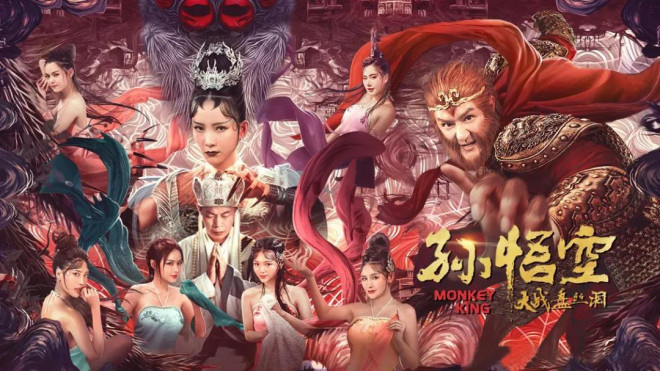
Special feature of 1905 film network "I read the whole The Journey to the West at the age of nine, but this is the first time I have officially made the theme of this wonderful book. I have fulfilled my wish. "


When Jing Wong, 65, recommended his new online movie "the Monkey King vs. Pansi Cave", he unabashedly referred to it as "a childhood dream".


After the film was launched, it quickly reached the top of the Japanese list. At present, the cumulative broadcast volume has reached 56.45 million, ranking among the best online movies in the same period.


However, "the Monkey King vs. Pansi Cave" suffered a word-of-mouth "Waterloo" on Douban, with a score of only 3.0, and 64.5% of netizens gave a one-star bad review. The key words are "shocking plot", "rough special effects" and "awkward lines", and "Made in Jing Wong" once again encounters the embarrassing situation of "not being well received".


With a keen business sense, Jing Wong became one of the earliest Hong Kong directors to enter the online movie market. At the same time as Jing Wong, even earlier, a group of Hong Kong filmmakers firmly established themselves in the phalanx of online movies on the way "all the way up". It is a two-way choice for Hong Kong filmmakers to enter the online movie market, but both of them are in urgent need of a break in the face of the question of "speculating on cold rice" and "living on their laurels".


Jing Wong’s online movie business. 


As early as 2015, Jing Wong entered the online market of "Blue Ocean" and signed a cooperation agreement with iQiyi for six films.


A year later, Jing Wong produced and wrote the first online drama My Goddess of Need. The film continues the routine of urban romantic comedy that Jing Wong is good at, bringing in Ekin Cheng, Chrissie Chau and other quasi-cinema stars, and the number of hits has exceeded 30 million in five days.


Coupled with the investment claimed to be over 10 million, this "My Goddess of Need" stirred up a lot of water in the online market at that time.


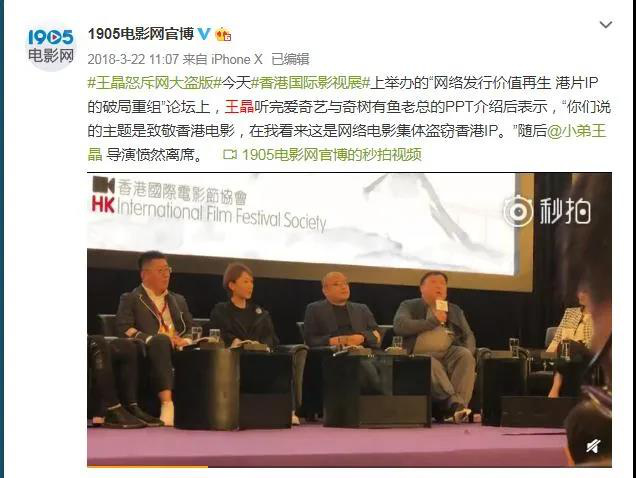
In 2018, at the forum of "Regeneration of Network Distribution Value-Breakdown and Reorganization of Hong Kong Film IP", Jing Wong suddenly angered the chaos of "plagiarism" of online movies. "The theme you said is to pay tribute to Hong Kong movies. In my opinion, this is a collective theft of Hong Kong IP by online movies … without giving any fees to any intellectual property owner or even asking for permission."


Jing Wong’s words poked at the crux of the shoddy and plagiarism in the online market at that time, and also revealed the recognized creative shortcut in the Chinese online market from one side.


In the cinema film market, the argument that "Hong Kong films are dead" will be rampant from time to time, but in the online market, the classic Hong Kong IP is welcoming round after round of "resurrection" in various forms.


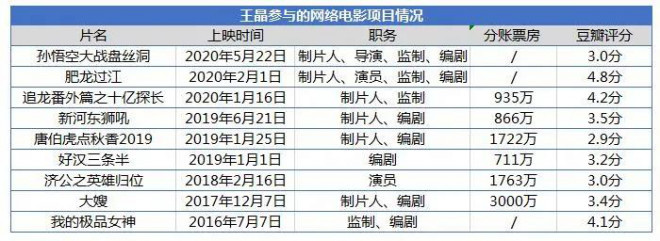
Looking at the nearly ten online works that Jing Wong participated in, it is not difficult to find that he himself can’t avoid the custom in the matter of "speculating IP".


"New lion roars" and "Tang Bohu Dianchouxiang 2019" are obviously based on the classic Hong Kong film IP. "Detective Billion" is an online spin-off he launched after the success of cinema films. "Flying Dragon Crossing the River" also pays tribute to the classic Hong Kong Kung Fu comedy from the title to the plot.


This time, "the Monkey King War Pansi Cave" is no exception. "Journey to the West" is one of the most classic themes of Hong Kong films. From the series of "Journey to the West" to "Journey to the West to Demon/Evil", it is not uncommon but often new.


This time, Jing Wong also invited Luo Jiaying, who played the Tang Priest in A Chinese Odyssey, and Benny Chan, the Monkey King, who played the Monkey King in the Hong Kong drama "Journey to the West II", together with several new "crystal girls" and erotic and comedy elements that Jing Wong is good at, to complete a "self-respect" emotional output.


However, like Jing Wong’s works in recent years, "the Monkey King vs. Pansi Cave" still cannot escape the dilemma of "disappointing performance". "Fried cold rice" and "king of rotten films" have once again become the key words of various film reviews.


In the face of doubts and negative comments, Jing Wong seems to have already practiced "invulnerability". What he often says seems to be still applicable in the context of online movies. "It is far more effective for viewers to vote with money than for critics to vote with their mouths."


There are only a few hundred people evaluating online movies on Douban, and the users of Douban are not in the same circle as the mainstream audience of online movies. Platform broadcast volume and box office are far more commercial than Douban score, which is also the basis for Jing Wong to speak this language.


Talking about the cooperation with Jing Wong, Gong Yu, CEO of iQiyi, once commented on him as "the director with the most Internet genes in Chinese movies" and "he has been making movies with the Internet thinking of product managers." Jing Wong even boldly predicted: "The Internet will replace the traditional cinema, and I am willing to take this step first."


It is not difficult to see that the logic of commercial movies that Jing Wong believes in coincides with the emphasis on low-cost and fast-paced online movie market. Online movie audiences’ preference for strong genre and "heavy taste" movies is exactly what Jing Wong wants. It can be said that Jing Wong, which has always regarded movies as commodities, is active in the online movie market, which is a two-way choice and the result of the times.


Hong Kong’s "Playing Bone" on the Net 


There are many "old friends" such as Benny Chan, Lin Zicong, Zheng Zeshi, Luo Jiaying and Chen Baixiang in Jing Wong’s online movie projects. They used to be "familiar faces" in classic Hong Kong films, but now they are frequently active in the online movie market, which holds up "half the sky" of Chinese online movies with a high-yield rhythm of Toshitabe.


The Monkey King vs. Pansi Cave is not the first time that Benny Chan and Lin Zicong have played the Monkey King and Zhu Bajie in online movies. As early as "Fighting against Buddha" and "The Great Sage of Qi Tian and the City of All Demons", they once starred together. Coupled with the cooperation in the "Jigong" series, the combination of Chen and Erh Lin has been deeply rooted in the hearts of online movie audiences.


Since 2017, the number of online movies starring Benny Chan has exceeded 20, and there will be as many as 6 movies in 2020 alone. In the "TOP10 list of China Internet’s great influence" released at the beginning of the year, Benny Chan ranked third and became one of the hottest actors in Internet University.


Fan Shaohuang, a "virtual bamboo" who is also well-known to the audience for "Eight Dragons", has also regarded online movies as its main battlefield in recent years. From The Great Sage Conquers the Demon, The Monkey King’s Screaming at the Dragon Palace to the series of modern action films, The Green Legion with Special Mission and Action of Wolves, Fan Shaohuang’s films are more diverse.


In addition to these Hong Kong actors who have become the "backbone" of the online movie market all the way up the road, there are also many "golden leaves" in Hong Kong films and Hong Kong dramas that glow with "second spring" in online movies.


"Pomegranate Sister" King-Tan Yuen starred in more than 10 online movies such as "Tang Bohu Dianqiuxiang 2019", and 70-year-old "charterer" Yuan Wah and "charterer" Yuan Qiu are still in their prime. Luo Jiaying, Zheng Zeshi, Ng Man Tat, and Xu Shaoqiang also appeared in a lot of online works.


In addition, Deric Wan, Xie Tianhua, Lv Liangwei and other actors, Kathy CHAU, Kristy Yang, Carman Lee and other actresses have also tried the net more or less. Online movies have become a "gathering place" for the older generation of Hong Kong movie stars.


Similar to Jing Wong, the interaction between Hong Kong actors and online movies is also a "two-way choice" process.


Wei Junzi, a film critic, said in an interview that the mainstream audience of online movies is very similar to the audience of the "golden age" of Hong Kong movies. On the one hand, their movie-watching choices are greatly influenced by "inertia", and they have a natural affinity for familiar themes and actors.


These popular Hong Kong IP films and "bone-playing" actors can often achieve twice the result with half the effort. The collaboration between Benny Chan and Carman Lee in "The Flame Mountain of the Great Sage in the Monkey King" triggered a discussion on the topic of "Duan Yu and Wang Yuyan meet again", which was easily searched in Weibo.


In the recent phenomenal online movie Ghost Story: Human Love, Yuan Wah’s re-performance of Yan Chixia and Xu Shaoqiang’s cross-dressing "Grandma" has also become one of the publicity points.


On the other hand, the low-cost and fast-paced creative mode of online movies is also very similar to that of Hong Kong movies. These actors, who have been tempered by the Hong Kong film industry with an annual output of several hundred films, are highly adaptable, and with their professional acting skills and reasonable pay, they naturally become the first choice for the big network crew.


Zheng Zeshi, the "Fat Cat", once recalled the year in the Tucao Conference, lamenting that when Hong Kong was hit by the financial crisis, only the Jing Wong film crew started work. Although many bad films were made, it supported a group of Hong Kong filmmakers.


Nowadays, the mixed online movies have similar significance to Hong Kong filmmakers. After all, for many pragmatic practitioners, film is a business, and "it’s a big deal."


In the first quarter of 2020, the total amount of TOP 30 online movies reached 430 million, and there were 23 films with over 10 million accounts, an increase of 188% over the same period last year. Facing the broad market prospect, online movies put forward higher requirements for quality. Last October, the "Internet Movie" was officially renamed as "Internet Movie", which also expressed the industry’s determination to bid farewell to the shoddy "Internet Movie" era.


Some analysts have suggested that the online movie market will gradually enter the "word-of-mouth-driven 3.0 era" from the "genre-driven 2.0 era" — — Good stories and good acting skills are the core, returning to the content itself, and driving the box office with user word of mouth.


Under the tide of "high-quality" online movies, if Hong Kong filmmakers only focus on self-repetition, they will inevitably be abandoned by the audience one day, which is foreshadowed by a large number of negative comments on "the Monkey King vs. Pansidong".


In the face of online movie audiences whose aesthetics are constantly improving, both Jing Wong and Hongkong filmmakers need to show more sincerity.


The Ministry of Education issued a notice to deploy and do a good job in the employment and entrepreneurship of college graduates in 2024.

  CCTV News:A few days ago, the Ministry of Education issued the Notice on Doing a Good Job in the Employment and Entrepreneurship of College Graduates in 2024 (hereinafter referred to as the "Notice"), deployed colleges and universities around the country to thoroughly implement the decision-making arrangements of the CPC Central Committee and the State Council, implemented the "Promotion Action for Employment and Entrepreneurship of College Graduates in 2024", and took various measures to promote the employment of college graduates.

  The Notice points out that college graduates are valuable human resources of the country. Colleges and universities around the country should take the employment of college graduates as the top priority and put it in a more prominent position, improve the employment promotion mechanism, strengthen overall deployment, collaborative linkage and university responsibility, and mobilize all forces to form a joint force for all employees to promote employment.

  The "Notice" emphasizes vigorously developing market-oriented socialized employment channels. We will continue to carry out the "Special Action for College Secretaries and Presidents to Visit Enterprises to Promote Employment", conscientiously implement the requirements of "two hundred" and improve the effectiveness of visiting enterprises to expand their posts. Promote the implementation of the "All Enterprises Enter the Campus" plan to provide more high-quality job information for graduates. Comprehensively promote the use of the national employment service platform for college students, and carry out the "24365 work together to promote employment precision service" in depth. Give full play to the role of national committees and trade associations, and strengthen the construction of sub-industry and sub-regional employment markets. Increase the recruitment and promotion of private enterprises and small and medium-sized enterprises, and encourage small and medium-sized enterprises to attract more college graduates.

  The "Notice" clarifies that the role of policy posts should be given full play. Promote all localities and departments to arrange recruitment examinations for party and government organs, institutions and state-owned enterprises as soon as possible, and all kinds of entrance examinations and vocational qualification examinations, so as to gain more job-seeking time for graduates. Vigorously explore the employment space at the grassroots level, continue to organize and implement grassroots employment projects such as "Special Post Plan", "Three Supports and One Support" and "Western Plan", and expand the implementation of "Special Plan for Urban and Rural Communities" and "Special Plan for College Students and Rural Doctors". Encourage all localities to introduce preferential policies to attract more graduates to work and start businesses at the grassroots level. Smooth the green channel for enlistment and actively encourage college graduates to enlist in the army.

  The "Notice" requires that the construction of a high-quality employment guidance service system be promoted. Take employment education and concept guidance as the important contents of "three-round education" and guide graduates to establish correct views on success, occupation and employment. Strengthen career education and employment guidance, revise and improve the teaching requirements of employment guidance courses, and select and create a number of excellent employment guidance courses and teaching materials. Make full use of modern information technology to provide students with personalized, accurate and convenient employment guidance services. Run the first national college students’ career planning competition well. Strengthen the practice of employment practice to help students enhance their employability and obtain employment opportunities. Actively create an equal employment environment and earnestly safeguard the employment rights and interests of graduates. Focus on graduates from poverty-stricken families, low-income families, zero-employment families, disabled people and other difficult groups, establish a help account, and provide "one-on-one" accurate employment assistance. In-depth implementation of the "Hongzhi Navigation Aid Plan". Promote counterpart employment assistance.

  The Notice emphasizes improving the employment monitoring and evaluation feedback mechanism. Conscientiously implement the registration system of graduation destination, strictly implement the requirements of "four no’s" and "three no’s" in employment monitoring, and ensure that the employment data is true and accurate. Further improve the comprehensive evaluation index system of employment work, get rid of the single evaluation orientation, and promote all localities and universities to comprehensively improve their employment ability and service level. We will improve the feedback mechanism of employment status, carry out in-depth follow-up surveys on the employment status of college graduates, continue to implement the red and yellow card prompt system for the implementation rate of graduates, guide colleges and universities to optimize and adjust disciplines and majors in time, and improve the quality of personnel training.

  The "Notice" requires that all local colleges and universities should earnestly implement the "number one" project of employment, and gradually compact their work responsibilities to ensure the safety and stability of employment. Conscientiously implement the requirements of "four in place" for institutions, personnel, venues and funds, strengthen the construction of provincial education administrative departments and employment service institutions and work teams in colleges and universities, and equip school-level employment staff in proportion. Vigorously carry out employment summary propaganda, promote employment policy propaganda into parks, enterprises, universities and communities, widely publicize the good experiences and practices of universities and employers in various places to promote employment, and actively create a good atmosphere for the whole society to care for and support the employment of college graduates.

The Loss of Maotai Cattle: From "Difficult to Grab" to "Don’t Want to Grab"

The liquor industry as a whole is in a downturn. How to burn Zhang Deqin’s "three fires"?

"Hard currency" Maotai is no longer fragrant? 

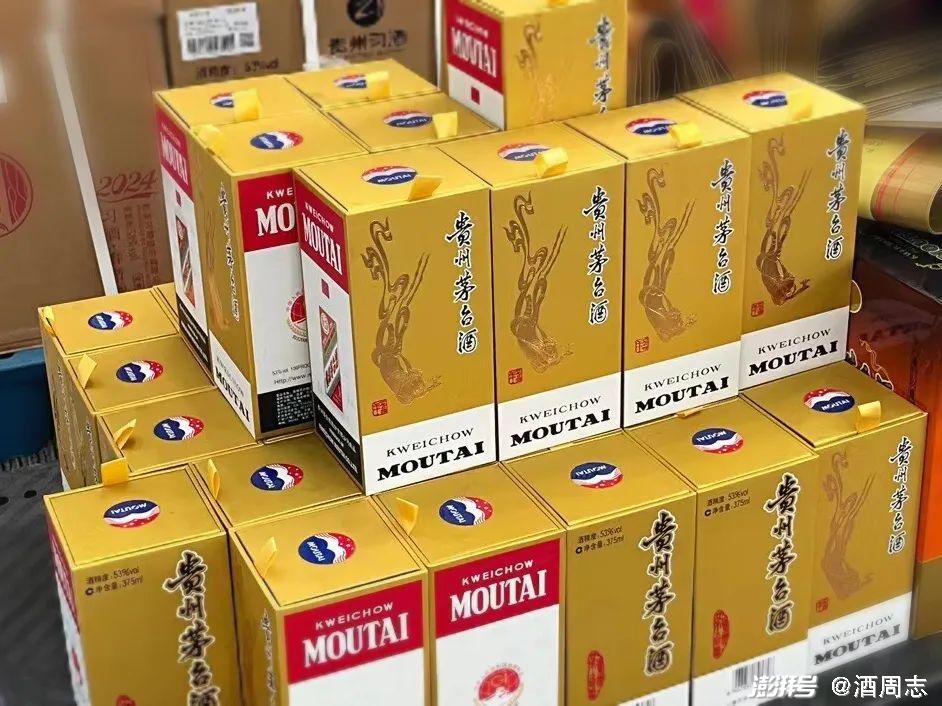
Since the beginning of this year, the price of Maotai has continued to drop, and even the hottest Feitian Maotai has fallen below 2,500 yuan: according to the latest wholesale data of today’s wine price on May 21, the wholesale price of bulk Feitian Maotai in 2024 was 2,495 yuan, and the original box was 2,760 yuan; The price of Bairong wine is 2,500 yuan and 2,760 yuan respectively. 

Jiu Zhouzhi visited the Beijing market. In some dealer channels, the lowest price of this product can reach about 2550 yuan, which is basically the same as the batch price. 

The price of Maotai fluctuated greatly, and some scalpers shouted "I can’t hold it". Some scalpers have stopped collecting the zodiac Maotai, or chose to leave temporarily. Maotai’s crazy "national ox" era seems to be gone forever. 

Jiu Zhouzhi consulted Kweichow Moutai on this phenomenon as an investor. The official said that the production, operation and marketing were normal. What the company can do is to do a good job in ecology and sales, and the company’s internal governance is good.

The scalper has lost weight, and the dealer is anxious.

"Flying Maotai is now a price a day, and I dare not overcharge it, for fear that the price will not rise in the future." Mr. Zeng, a scalper who has been engaged in Moutai business, told Jiu Zhouzhi.

The owner of a national wine collection in Changping, Beijing, said that because there is no flying quota, they have no price advantage. In order to ensure the quantity and authenticity of the supply, in addition to daily wine collection, they also set up a "Mao Mao Group" and organized group friends to make appointments on platforms such as "Huluwa". "However, it is not a small cost to advance the whole process and return the commission. Now the transaction price has fallen, which has greatly affected the profit, and it is very difficult to get out." 

In fact, it’s not just the scalpers who feel uncomfortable. A Kweichow Moutai dealer in Chaoyang District also said that the overall market of Maotai is general now, and most of the high-profit products are sold directly. "Although we also have quotas, we have to bundle the goods with low-profit products, which is not big." 

In addition, in addition to the price decline of Feitian Maotai, Maotai vintage wine, Zodiac wine and series wine have also declined to varying degrees, and the liquidity in the liquor circle is not as good as in previous years. 

For example, according to many dealers and scalpers, the price of Zodiac wine, which has been "fried", continues to fall, among which Festuca arundinacea and Mafao have the highest prices because of their low output. "The prices of the two are around 30,000 and 20,000 respectively", and the prices of other Zodiac wines as a whole show a gradual downward trend. 

Among them, rabbit hair is the cheapest Maotai Zodiac wine. At the retail end, the recycling price given by dealers and scalpers is 2,600-2,800 yuan, while the selling price is around 3,000 yuan. Many scalpers said that the profit of fried zodiac wine may not be as good as that of Pumao. 

Before the explosion of I Maotai, 100ml flying Maotai and Maotai 1935 had already encountered "Waterloo" in the terminal market. Today’s wine price shows that the wholesale price of the former is basically maintained in 380 yuan -400 yuan, while the wholesale price of the latter is 1030 yuan. In retail terminal stores, the price inversion of Maotai 1935 is more serious, with the price range of 900-1000 yuan. 

At the same time, from May 19, Maotai 1935 has changed from reservation subscription to cloud purchase, which can be purchased directly; The delivery mode of 100ml Feitian Maotai also started nationwide delivery. The future trend of these two products has been questioned by the industry. 

Jiu Zhouzhi found that scalpers with small business volume said that they would suspend the acquisition of Maotai Zodiac wine, and some scalpers even bluntly said that they would suspend the acquisition of all products. On some platforms that share the price of Moutai, fans will even be specially reminded that Maotai 1935, fine Maotai and other products are lower than the snap price, and many places do not accept them. Please proceed with caution. 

Why did this happen?

Maotai, which is high above, also has a day when it can’t move? 

The most fundamental reason is that the relationship between supply and demand has changed. On the other side of high social inventory, there is a decrease in social demand and consumption power.

Brewmaster Zhang, a liquor appraiser, told Zhou Zhi that on the one hand, the current business consumption scenarios are decreasing, and the demand for superposition is decreasing, but Maotai is still increasing its production capacity; On the other hand, the reservoir of Maotai is also getting smaller. Many scalpers are not dealers and have no price advantage. In the past two years, Maotai has not risen but fallen, and they dare not hoard a lot of goods. 

"The price fluctuation of Maotai is divided into external factors and internal factors. The external factors are nothing more than economic fluctuation, policy influence, investment environment and even liquor inventory. For example, when the channel inventory is high, some distributors will choose to sell to alleviate the cash flow tension, thus causing the price fluctuation of Maotai," added Ouyang Qianli, a researcher in the wine industry. "The internal factors are more supply and demand, channel changes, product mix and even management changes. With the continuous improvement of Maotai’s production capacity and the increase of direct sales ratio, etc. 

Secondly, the price of Maotai new wine and old wine is getting closer and closer, which also means that the profit space through hoarding wine is shrinking, thus affecting the confidence of wine merchants.

Mr. Hu, a senior wine collector, told Zhou Zhi that scarcity is one of the important factors affecting the terminal market price of old wine. In recent years, the continuous expansion of Kweichow Moutai will weaken the scarcity of sub-new wine to a certain extent. When the sub-new wine gradually becomes old wine, the scarcity is not strong due to the large output, which will directly affect the future market transaction price. 

The following set of data also supports Mr. Hu’s view that the price of sub-new wine products is the same as the current transaction price of the 53-degree flying Maotai terminal market in 2024. According to the latest data of wine board, the terminal transaction price of Feitian Maotai (bulk bottle) products in 2017-2024 is about 2880 yuan, 2800 yuan, 2760 yuan, 2690 yuan, 2640 yuan, 2600 yuan, 2525 yuan and 2520 yuan respectively. 

In his view, "Moreover, wine merchants have different channels to get goods and different costs. When Moutai fell, some scalpers/dealers chose to throw goods, which led to a chain reaction in the market." 

Thirdly, from the perspective of brand value, in order to promote the rejuvenation of Maotai brand, Maotai ice cream, sauce-flavored latte and other products have been launched successively, which has lowered the tonality of Maotai in the eyes of some scalpers, which is not conducive to maintaining the price of Maotai.

For the frequent cross-border of Maotai, there are two main reasons for market dissatisfaction. First, the cross-border joint name of Maotai can be ignored compared with its revenue of 100 billion yuan. Second, Maotai is essentially a high-end consumer product similar to luxury goods. Cross-border consumer goods lower the consumption threshold of users, and there is a risk of brand overdraft. 

Some cattle stopped buying Zodiac wine, which was not only related to the output, but also an important reason why some cattle dared not touch it.

According to many dealers and scalpers, Maotai Zodiac Wine is the most easily "topped" Moutai, and there are many high-quality imitations on the market at present. Because the packaging materials are all true, it is difficult to confirm the authenticity through Maotai’s secret record, and the identification standard is also vague. 

The market is waiting for the "three fires" of Maotai’s new coach

After Zhang Deqin, the new "top leader" of Maotai, came to power, the industry thought that the most urgent task was: first, whether the price of wine could be maintained; The second is to strike a balance, including the balance between direct sales and traditional dealer channels, and the balance between supply and demand. 

Regarding the matter of price stability, Ouyang Qianli said that for Zhang Deqin, the core is to make dealers profitable. For example, when distributing goods to dealers, Feitian Maotai should be the main product, supplemented by other products; In addition, comb the product structure and cut down the products that are detrimental to the brand power; Strive to improve the bottle opening rate, adjust the health of social inventory, and so on. 

How to balance the direct marketing and dealer channels, boost the confidence of dealers and repair the relationship with them is another big challenge for Zhang Deqin.

There is such a voice in the market that traditional channel dealers have made great contributions to helping Maotai obtain today’s public awareness and price expectations. Under the background that the proportion of Maotai’s direct sales has exceeded 40%, manufacturers need to balance the interests of direct sales and traditional dealer channels to ensure the harmonious coexistence of both parties. 

Some insiders pointed out that Zhang Deqin, who grew up at the grassroots level in Maotai, knows both technology and market, works pragmatically, dares to be responsible, and is very human to employees and distributors. This time, Zhang Deqin was transferred to take charge of the overall situation, which will play an important role in stabilizing the confidence of investors and Moutai upstream and downstream industrial chain partners, especially in stabilizing the market price of Moutai. 

In fact, since Zhang Deqin took office on April 29, he has made many public speeches focusing on Maotai’s dealer strategy. He said at the Zhejiang-Fujian-Su Sansheng Dealer Symposium on May 10: "Dealers are Maotai’s family, and we will continue to respect and safeguard their interests." 

However, when Jiu Zhouzhi visited the market, he noticed that the dealers were not optimistic that Zhang Deqin could alleviate the current situation of Maotai’s price drop in a short period of time, but interestingly, they were still optimistic about the long-term development of Maotai. "After all, in the current era of liquor stock, the market is weak, and Maotai is the only brand that can make money at present." The owner of a Maotai sauce-flavored Wanjia shared store said. 

In addition, with the "fixed file" of Kweichow Moutai shareholders’ meeting after May 29th, all parties, including shareholders, distributors and scalpers, are paying attention to what new signals will be released by this shareholders’ meeting. It is worth mentioning that at present, Maotai International Hotel has become "hard to find a room", and most of the rooms on May 28th and 29th have been sold out, leaving only a luxury villa of 8998 yuan a night. 

However, the above-mentioned staff of Kweichow Moutai said that (whether the new head will introduce new policies and other issues) is not the scope of discussion at the shareholders’ meeting. "This is at the operational level and belongs to the board of directors."

What kind of answer sheet will Zhang Deqin’s "first show" hand over? What new changes and breakthroughs will Kweichow Moutai usher in? All parties are looking forward to how to burn their "three fires". After all, the current liquor market needs a shot in the arm. 

The latest development of the second phase of Metro Line 13: the shield of "Attack No.3" was successfully launched.

Line 13 Phase II (North Extension)

New developments from the front ~

01

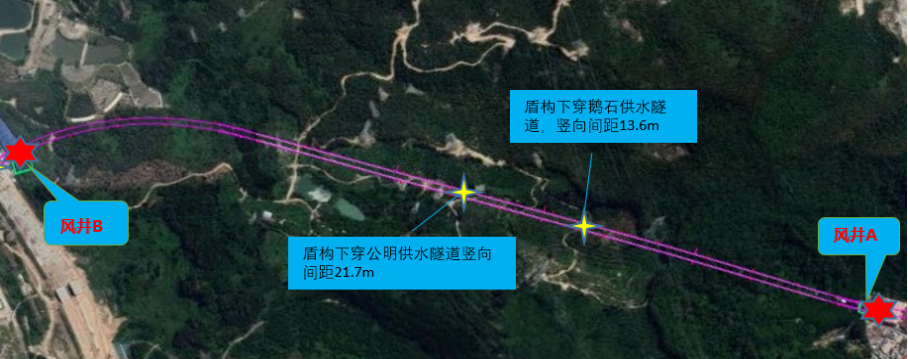
Wind well a ~ wind well b interval

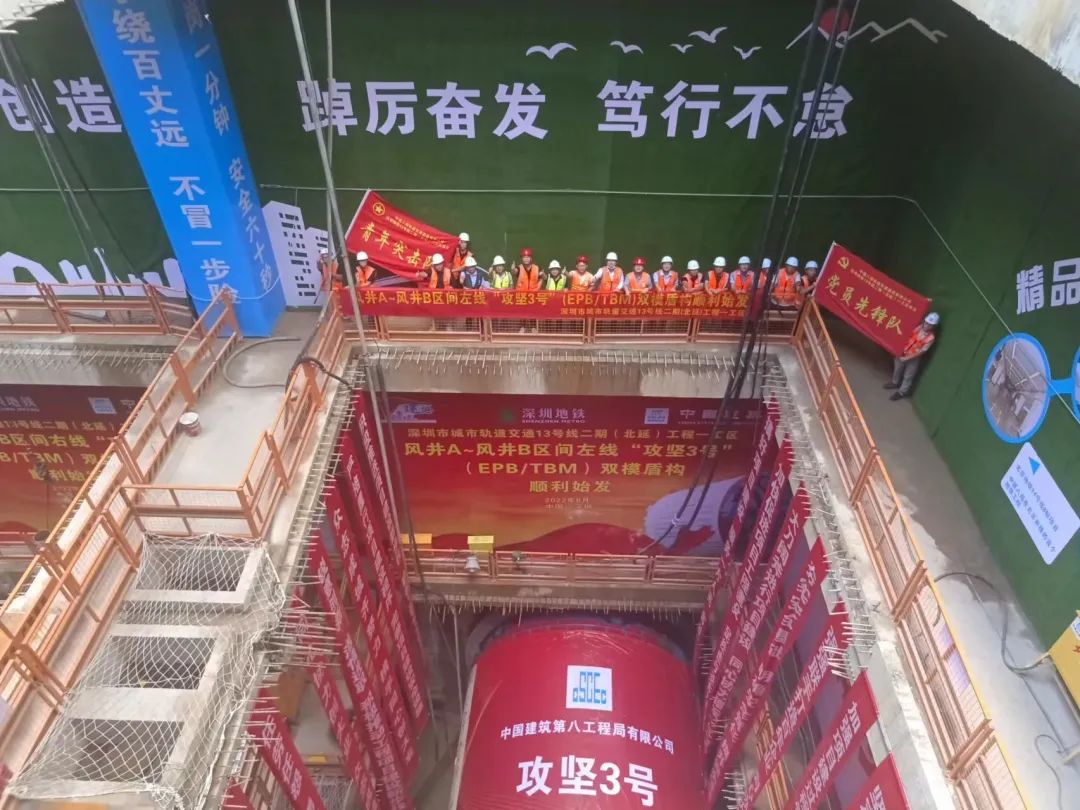
Left-line shield started smoothly.

Work Area 1 of Phase II (North Extension) Project of Metro Line 13

Wind well a ~ wind well b interval

The left line "attack 3" shield started smoothly.

This is the interval between Shangwu Station and Municipal Hospital of Traditional Chinese Medicine Station.

The originating third shield machine

It marks that the project has entered a new stage of shield construction.

The successfully-launched "attack No.3" will pass through Gongming Water Supply Tunnel, E-Shi Water Supply Tunnel and Dayanshan Mountain in turn, with the total length of the left line of the interval of 1,736 meters. The main crossing strata are slightly weathered biotite granite schist, moderately weathered biotite granite schist, strongly weathered fault fractured rock, moderately weathered fault fractured rock and slightly weathered biotite granite.

Affected by bad geology, the shield construction in this section is difficult, mainly reflected in:

First, the rock hardness is high and the rock mass is complete

The basic quality grade is Grade II, the mineral composition is mainly Shi Ying, feldspar and mica, and the rock is dense and hard. Long distance hard rock excavation poses a great test for shield machine equipment.

Second, the shield machine needs to cross the fracture zone where the rock mass is broken.

Affected by the fault structure, the driving conditions are poor. There are some problems in the process of shield tunneling, such as large deformation of surrounding rock at fault zone, easy collapse of tunnel face and difficult control of tunneling direction.

Interval length

Various systems of the relevant contractors are linked and planned in advance, and the following measures are taken to ensure the smooth start of the shield:

First, carefully select shield equipment.

"attack 3" isA new EPB/TBM dual-mode shield machine based on TBMThe equipment has five key technologies to meet the needs of shield tunneling.

Second, flexibly solve the difficulties in equipment transportation.

In view of the bad transportation road conditions, the relevant contractors and road administration units negotiate and communicate, and choose hoisting equipment at night to enter the site, which will not affect daytime driving.

At the same time, the work area was planned in advance, and after detailed reconnaissance along the line, the peripheral parts were dismantled and assembled successfully by means of parts transportation, ensuring the smooth entry of shield facilities.

Third, attach great importance to the problem of security risks.

Relevant contractors have always kept the string of safety in production tight, and paid strict attention to production safety, quality control, epidemic prevention and control, flood prevention and emergency, etc., in order to reduce production risks, eliminate hidden dangers and ensure high-quality and efficient performance of the project.

Hoisting equipment

02

Line 13 Phase II (North Extension)

A connection

Nanshan, Baoan and Guangming commuter express lines

The second phase (north extension) of Line 13 starts from Shangwu Station (excluding) and ends at Gongming North Station.

The total length of the line is about 19.23 Km, set up a station 11 Block, depot one Seat. All of them are laid underground.

▲ Schematic diagram of the second phase (north extension) of Line 13 (the name of the station is subject to the actual completion)

Up to now, the second phase (north extension) project of Shenzhen Metro Line 13 has been completed. 17 All the open excavation sites have been put into construction, among which-

10A worksite completes enclosure of the enclosure structure,fiveThe main structure of each worksite is capped;

Shield well 19Number of stations, origin 16Taiji;

three A tunnel runs through a single line;

oneA subsidiary structure is enclosed.

Line 13 Phase II (North Extension) starts in series.

Guangming district science citycentrePhoenix

When completed, it will effectively support the light.

Accelerate the construction of a world-class science city and the northern center of Shenzhen.

After being connected in series with Line 13 and the south extension of Line 13

The future will run through lightBaoanMt. Nan

Three administrative regions

Nanlian Hong Kong North connection Dongguan

when the time comes

It will effectively boost the integrated development of Shenzhen Special Economic Zone.

To build "Greater Bay Area on the track"

"Bay Area Interconnection" Traffic Pattern

Has important and far-reaching significance.

Source: Shenzhen Rail Office