[Our Ten Years @ Coordinate China] "Deep Sea No.1": Deep-sea heavyweights bravely "dive"
In the middle of the South China Sea, the deep blue water reflects the bright yellow steel frame structure, "Deep Sea No.1" — — This steel giant, which continuously transports natural gas, shines in the sun.
On January 14th, 2021, CNOOC China announced the world’s first 100,000-ton deepwater semi-submersible production and storage platform — — "Deep Sea No.1" energy station was delivered and set sail in Yantai, Shandong Province, and officially put into operation in Lingshui, Hainan on June 25th of the same year, which was used to develop China’s first 1,500m deep-water self-operated gas field — — Lingshui 17-2 gas field marks a new stage of offshore oil and gas exploration and development in China.
The great power weapon "Deep Sea No.1", which is condensed by several generations of China CNOOC relay research, has turned the legend into reality. Countless CNOOC people in China braved difficulties, courageously competed for the first place and set a precedent, knocking on the door of the ultra-deep sea energy treasure. Every day, 10 million cubic meters of natural gas is continuously mined from the seabed 1,500 meters, and finally reaches thousands of households, turning into smoke.
Advancing into the deep sea creates not only a new depth of China, but also a new future for Chinese.

Ingeniously forging CNOOC exploration into "ultra-deep water era"
The sea area with a water depth of more than 1,500 meters is generally defined as "ultra-deep water" in the world, and most of the oil and gas distributed here are in a state of "visible and unreachable", because the quantitative change of water depth brings about the qualitative change of development difficulty.
How easy is it to advance into the deep sea?
Below sea level, for every 10m increase in water depth, the underwater equipment will bear an extra atmospheric pressure; When the water depth exceeds 1000 meters, the seawater temperature also drops from the average temperature of more than 10 degrees Celsius to about 5 degrees Celsius, which has an impact on the state of oil and gas. When reaching the seabed, the huge and soft sand ridges will make it difficult for production equipment to land stably, not to mention the common internal waves and typhoon weather in the South China Sea.
In 2014, the "Deep Sea No.1" gas field located in Qiongdongnan Basin was discovered. Its proven natural gas reserves exceeded 100 billion cubic meters, the maximum water depth exceeded 1,500 meters, and the maximum well depth exceeded 4,000 meters. It is an offshore ultra-deep water gas field with the deepest average water depth and the most difficult exploration and development in China. The development of deepwater oil and gas fields is a world-class problem, especially for China, where offshore oil started late.
The builders of China CNOOC will face not only great challenges from the ocean itself, but also technical challenges. The construction of offshore energy station is not only lack of precedent and short construction period, but also must be designed and built according to high quality standards such as "no docking for 30 years". Only the lower hull is composed of 240,000 parts, which is extremely difficult to design and build. You Xuegang, general manager of China CNOOC’s "Deep Sea No.1" gas field development project, said, "Although China’s shallow water oil exploitation capacity has reached the world advanced level, deep water oil and gas field development ‘ No technology, no resources and no experience ’ The situation in the early stage of gas field development is constant. "
In the face of difficulties, the development and production team of "Deep Sea No.1" led thousands of construction workers, overcame many difficulties, worked day and night, and completed the hull construction, the upper block construction and the "Dahelong" of two blocks with high quality. By the end of 2020, it took China CNOOC only one and a half years to build the platform, setting a record of 18 months ahead of the construction period of similar platforms in the world.
Located in the southeast of Qiong, it is proudly a big MAC. Behind the successful production of "Deep Sea No.1", the wisdom and creation of several generations of offshore oil industry builders have been condensed for years. Thanks to the "deep water fleet" that runs through the entire industrial chain, China’s offshore oil exploration and development capacity has completed a historic leap from 300 meters to 1,500 meters, and officially entered the "ultra-deep water era".

On February 6, 2021, the "Deep Sea No.1" energy station successfully arrived in the Lingshui sea area in the southeast of Hainan Island (Photo courtesy of China CNOOC).
Pioneering and innovating to achieve a number of key core technologies
“‘ Deep Sea No.1 ’ The energy station is huge in size, with a total weight of more than 50,000 tons. The maximum projected area is equivalent to the size of two standard football fields, with a total height of 120 meters, equivalent to 40 stories, and a maximum displacement of 110,000 tons, equivalent to three medium-sized aircraft carriers. The total length of its hull engineering weld is as high as 600,000 meters, which can surround Beijing Sixth Ring Road for 3 times. The length of the cable used is over 800 kilometers, which can surround Hainan Island for one week. " You Xuegang said.
How to make such a behemoth stand on the sea? How to fix the platform firmly on the sea? The development and production team of "Deep Sea No.1" gas field of China CNOOC pioneered and innovated, and came up with a wonderful solution: using 16 anchor chains for fixing the platform, which are made of high-end polyester fiber materials. One end of the anchor chains is tied to the four corners of the "Deep Sea No.1" platform, and the other end is tied to the seabed. The breaking force of each rope exceeds 2,000 tons, which can make the platform resist a typhoon of magnitude 16 and realize that it will not dock for 30 years. This is a technological breakthrough to break the international monopoly, and also reflects the rapid development of China’s offshore oil and gas equipment manufacturing capacity.
"Deep Sea No.1" is an atmospheric field that produces both gas and oil. The mixture of oil, gas, water, etc. buried in the deep stratum will enter "Deep Sea No.1" through underwater production equipment such as underwater manifold, jumper pipe and submarine pipeline. After a series of treatment by the equipment, the gas will find the gas pipeline, while the oil will go to another path.
"Deep Sea No.1" pioneered the column oil storage technology. With the help of the concept of "thermos tank", 5,000 cubic meters of condensate tanks were set in the four floating columns of the platform, and tailor-made "protective armor" was installed for the oil tanks, which not only solved the condensate storage problem, but also avoided the risk of oil body collision and leakage, and saved about 800 million yuan in cost. This enabled "Deep Sea No.1" to realize the integrated functions of condensate oil production, storage and export, and became the first 100,000-ton deepwater semi-submersible production and storage platform in the world.
There are many technological innovations like this. The builders of China CNOOC cracked the code of the deep-water treasure in the stormy waves. Deep Sea No.1 achieved three world-class innovations in the whole process of design, research and development and construction, and used 13 domestic pioneering technologies to overcome more than 10 industrial problems. It is a masterpiece in the field of marine engineering construction in China.
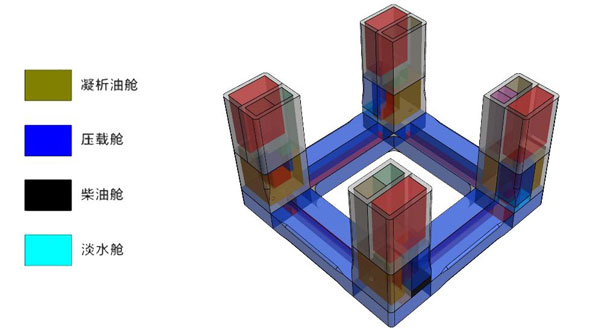
The world’s first vertical column oil storage technology (Photo courtesy of CNOOC China)
Concentrate on more than 5,000 builders to build a "deep sea weapon" with youth.
In the past year, the appearance of "Deep Sea One" surprised the world. Behind its successful production, more than 5,000 builders have been fighting silently for 7 years. In order to realize the simple wish of "using our own equipment and developing our own energy", let the builders of "Deep Sea No.1" bravely stand on the tide again and again, break through the endless deep sea, and prove to the world that even if it is as far-reaching as the sea, it can’t stop Chinese from arriving.
In order to ensure continuous gas production, offshore platforms are open all year round, and machinery and equipment operate 24 hours a day. At sea, each post will be reversed by two people, and a sea shift will work continuously for 28 days. Most of the time, life at sea is monotonous and repetitive. For offshore oil workers who are on duty on the front line, it is daily to grow up without their children and not be able to accompany their relatives on holidays.
Plum blossom fragrance comes from bitter cold. In June this year, the cumulative production of natural gas in the "Deep Sea No.1" ultra-deep water gas field exceeded 2 billion cubic meters, which is equivalent to solving the annual gas consumption of more than 5 million households, and has become an important support for the energy supply of Guangdong-Hong Kong-Macao Greater Bay Area and Hainan Free Trade Ports.
The construction, delivery and final commissioning of "Deep Sea No.1" have epoch-making milestone significance for China’s offshore oil industry. It not only marks a major breakthrough in China’s deep-water oil and gas field development capacity and the construction level of deep-water offshore engineering equipment, but also has great significance for improving China’s marine resources development capacity, ensuring national energy security and supporting the strategy of becoming a maritime power.
In the future, relying on "Deep-sea No.1", China will strive to intensify deep-water exploration and drive the development of new deep-water gas fields around it. It is estimated that by 2025, a trillion-dollar atmospheric zone in the South China Sea will be built to further enhance China’s clean energy supply capacity.

Builders and "Deep Sea No.1" (Photo courtesy of CNOOC China)
China depth, central enterprise structure. Advancing into the deep sea and serving the country with energy is the "peak" that CNOOC people in China have never given up climbing. When the lights are on, watching has a real meaning.