The secret of sales success, these 16 words.
What is "sales"?
In a nutshell, it is "selling things". Selling the company’s products is sales, and marketing yourself is also sales. Professionally speaking, it is "matching demand". From the "mission", it is "docking value"!
Sales should not only constantly understand and meet customers’ needs, give them appropriate products and services, but also do a good job in the window between enterprises and society to realize "value provision" and "value innovation".
Many domestic enterprises understand the definition of the sales department too shallowly, and when giving the assessment indicators to the sales department, they simply use the target achievement rate to evaluate the quality of a sales. This is very risky!
The same sales volume, different matching degree with the target customer’s demand, directly determines the difference in its final value.
Some people think that sales is an action and process of selling products, but I will regard "sales" and "business" as a concept more often.
The biggest difference between "Sales" and "Business" is that the former emphasizes more on how to "sell more things", while the latter emphasizes more on "making business bigger with your customers".
How to do business with your customers? "Win-win thinking".
What is the real "win-win thinking"?
Let me tell a very famous story about Alibaba first. Ma Yun encouraged employees at the beginning of his business. "When doing business, ordinary business people always stare at the 5 yuan in the customer’s pocket, hoping to earn that 5 yuan.
Now, what we have to do is not to stare at the 5 yuan in that pocket, but to help customers earn 50 yuan, and when customers earn 50 yuan, they will naturally be willing to take out 5 yuan in their pockets to reward us. "
This story talks about obtaining "win-win" from the perspective of "altruism", but it doesn’t really tell the essence of "win-win thinking".
For example, "Why can you help customers earn 50 yuan?" And "How long will it take to earn 50 yuan? If I can’t earn it in the short term, should I not spend time on this customer? " Indeed, "win-win thinking" is not as simple as its literal meaning seems.
Generally speaking, there are three misunderstandings about win-win situation.
The first misunderstanding is that there are no barriers to win-win.
There are two prerequisites for a win-win situation. First, do you have something that others want? In other words, it is "value". And there is another prerequisite, does the other party have the "value" you want?

So,Win-win is not simply beneficial to both sides, but both sides can get value from it.From another point of view, "win-win" is a way of cooperation based on the fact that both sides have their own values.
The second misunderstanding is that win-win only exists in long-term trading relationships.
When it comes to win-win, do you think it is short-term or long-term? Most people will answer this question: it is long-term. In other words, it is generally recognized that win-win cooperation will not happen in a one-time transaction.
However, have you noticed that many transactions only happen once? For example, when you pass a fruit stall or a coffee shop in a different place, it was because of the local environment that you made a one-time transaction and bought a single fruit or a cup of coffee. But if so, is there no win-win situation?
Actually, it is not. If you regard the win-win boundary as the total value of the current transaction, then it is indeed limited. But if you treat your customer not just as a customer, but as a communication channel, then the way you treat him is very different from the value he will bring you.
So,In win-win thinking, value not only refers to the transaction value, but also includes the potential value brought by the transaction.Therefore, it is not only the scene of multiple transactions that is worth talking about "win-win", but in any sales or trading scene, we need to cooperate with the idea of "win-win".
The third misunderstanding is that win-win only exists in mutually recognized relationships.
In the sales scene, there are too many various partners, some of whom are congenial to you, so the natural cooperation scene is very positive, but some partners are very difficult to engage in, even unreasonable and treacherous, so is it impossible to win together in this case?
In fact,All partners can bring you win-win opportunities, provided that the interaction and co-creation between the two parties bring value to each other, not consumption.
Many growing companies will thank their competitors for their repression. Nietzsche said that whatever can’t kill you will eventually make you stronger. Many customers will also upgrade the process control system of product enterprises through strict quality acceptance standards.
Therefore, the "positive and positive interaction" largely determines how you and your partners interact and continue this cooperation, and the interaction and co-creation between you in the long-term relationship system also largely determines the value innovation ability that your interaction can bring.
At this point, the basic definition of what I think is "win-win thinking" has basically been developed-win-win thinking is a way of thinking that is based on its own value, aims at pursuing long-term value, and promotes value appreciation and fission with the positive cooperative relationship of interaction and co-creation.
Simply put, it is the integration of three meanings:
First, it is based on the value it can provide;
The second is to pursue long-term value as the goal, and the effective way to achieve this goal is "altruistic thought";
Third, it is necessary to establish positive interaction and co-creation with partners, and bring new value added.
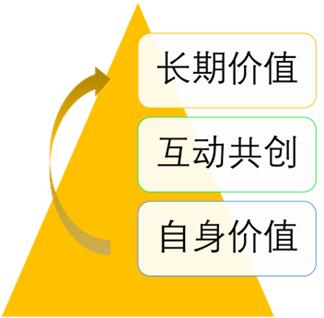
We can see from the picture that "self-value" is at the bottom of the pyramid, and it is also the cornerstone to achieve a win-win situation. The long-term value is at the top of the pyramid, which is the commanding height and goal of the future. In the middle is long-term partnership, interaction and co-creation.
How to judge whether a person already has a win-win thinking?
You may wish to refer to this self-evaluation form and give yourself a self-evaluation according to (1 ~ 5 points), which can also let you know more about whether you have or are practicing "win-win thinking".
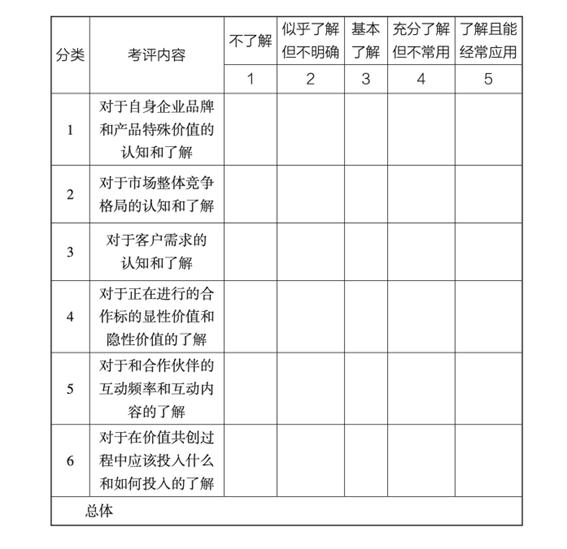
In this table, every question is worth thinking about. It doesn’t matter whether you are in the front line of business or whether your position is high or low within the company. The most important thing is that by understanding win-win thinking, you can see what has really been done and what is just "an armchair strategist".
If your comprehensive score is less than 10, then maybe your win-win thinking system needs to be improved, and we can discuss it further in the future.
And if your comprehensive score is above 20 points, it means that you already have the logical foundation of "win-win thinking", and we can discuss the subsequent sales landing system together.
"Win-win sales thinking" is also divided into three levels.
The first level, pay attention to "demand".
In other words, the realization of its own value is based on a clear external demand. Therefore, to do a good job in sales, we must understand that "transaction" is based on "demand", and the cognition and excavation of demand is the source of transaction.
The second level concerns "cooperation".
It is not enough to have a transaction. The development of business relationship stems from value creation, and "value creation" inevitably comes from the interaction and cooperation between the two parties. Therefore, to do a good job in sales, we should try our best to develop transactional cooperation into relational cooperation and actively cooperate with customers in value innovation.
The third level, pay attention to "self-progress".
Good sales should learn to examine their own value and operation system from the perspective of "customer first", constantly push enterprises to improve their product innovation and operation efficiency, and constantly force "self-progress" in the increasingly fierce competitive environment, and constantly win the recognition of customers and the market.
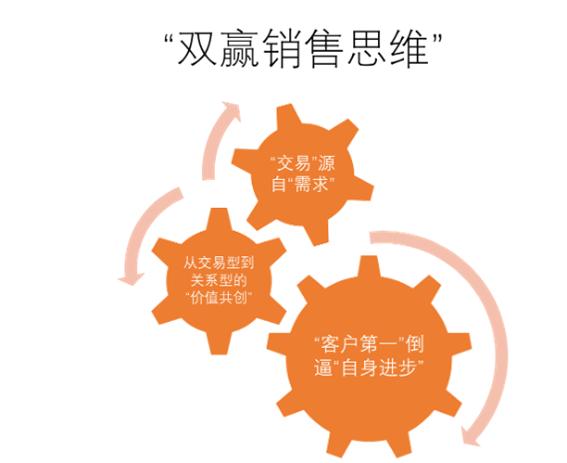
It is worth mentioning that the three concerns mentioned above are actually interlocking. We use a flywheel diagram to describe the overall logic of "win-win sales thinking"
The top "transaction" is the first goal that sales need to pay attention to most, and it is also the explicit result of sales. The gear of "transaction" is like the part of "iceberg" floating on the water, which has become a "dominant" state that everyone sees.
However, the "hidden" part is the "hidden" reason for the deep development of the business. In fact, the cooperative relationship brought by the exchange will really drive both parties to a new platform, and the "win-win sales thinking" will drive both parties to jointly invest and create new value, so that this transactional cooperation will become a relational value creation.
The bottom gear represents the promotion of the "self-value" of the enterprise. Enterprises constantly improve their management ability and product innovation around the needs of customers and market competition, so that their own value can be continuously improved and developed in a "win-win environment".
Whenever someone asks me to help him explain the secret of "clinching a sale", I will answer them with these 16-character mantra, that is, to understand, tap, satisfy and create "demand"!
1. Understand "demand": the beginning of all business.
What is the demand? Demand is divided into "needs" and "wants".
To understand the requirements, we should first understand what is the basic content that the other party "needs" and what is the optimized content that the other party "wants" besides the basic functions.
In the hierarchy of needs theory, Maslow divided it into physiological needs, security needs, belonging needs (three basic needs lacking) and respect needs and self-realization needs (two high-level needs growing).
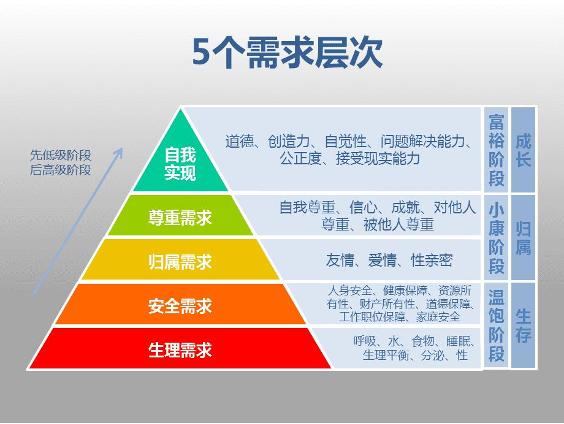
Later, people added high-level needs such as knowledge and aesthetics to the hierarchy. In the East, our ancestors have already combined our senses and needs together, collectively known as "worldly desires"-emotions, worries, sadness and fear, eyes, ears, nose, tongue, body and mind.
People’s understanding and perception of needs will change with the change of time, place and scene. The same is true of the business partners. When the time is right, the scene is right, and the people are right, often the demand can be truly transformed into a transaction.
2. Tap "demand": discover new opportunities and expand business.
Why should we "tap the demand"? Because sometimes, the customer himself may not know exactly what he "wants". In terms of tapping demand, the contrast between good salespeople and poor salespeople is particularly obvious.
When ordinary salespeople see the demand, they can’t wait to provide solutions to meet it as much as possible, while good salespeople will follow suit and dig slowly to find bigger gold mines and more essential problems.
3. Meet the "demand": realize the basic transaction of business.
It doesn’t need much explanation to meet the demand, but if you think it is easy to meet the demand, you are wrong. The products and services sold are prone to various problems in the delivery process, and it is impossible to achieve 100% high-quality delivery.
Because of this, customer service satisfaction is a very important indicator in the business system, and one of the very important indicators is NPS, which is the so-called "net recommendation value".
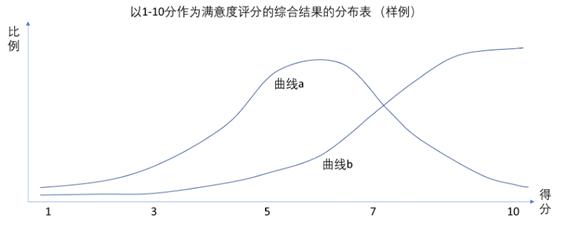
If we ask our customers to rate our product use and service experience, with 0 being the lowest and 10 being the highest, and 0 ~ 3 being very dissatisfied, 4 ~ 6 being average, 7 ~ 8 being satisfied but not exceeding expectations, and 9 ~ 10 being very satisfied and willing to recommend others, how many points do you think your products and services can be scored?
4. Create "demand": form the outward expansion of flywheel effect.
Why "creating demand" comes after "meeting demand" is actually because "creating demand" itself is based on the cooperative relationship between us and our customers. If the cooperative relationship has not yet begun, then what we can do at best can only be called "mining demand".
When the cooperative relationship begins, we can further understand the actual needs of customers through cooperation, and we can guide each other to realize the potential "new needs" through some heuristic questions. Often, when customers learn about the diversity of enterprise products and services through cooperation, they will be more willing to try solutions outside the original cooperation content.
In addition, through the three flywheels of the above "win-win sales thinking", we can also find that when the existing demand has been fully discovered and met, the subsequent expansion of the flywheel effect will drive the business development, that is, in the second gear, the "transactional" cooperation will be upgraded to "value creation" after the "relational" cooperation.

All business comes from demand. Without demand, there is no business.
Therefore, sales work is actually the matching and value exchange between solutions and requirements. If you can’t really understand this, it is very easy to miss by a mile.
Content source: the teacher contributed. Cheng Xi ‘an, a well-known marketing management expert, is currently the general manager of Novozymes OneHealth in China.
Rotating editor-in-chief| Zhiyong
Editor on duty & editor in charge| Kaneki Ken
This article comes from WeChat official account’s "Noteman" on WeChat (ID: Noteman), and is written by Cheng Xi ‘an and published by 36Kr with authorization.