What the hell happened? At an altitude of 8,000 meters, 11 people died in a week of "congestion"
Cctv newsSince the 20th of this month, a large number of climbers have rushed to the top of Mount Everest, and when they reached the "dead zone" at a height of 8,000 meters, there was a "congestion" scene. The death toll from climbing Mount Everest this year has increased to 11. Why are so many people killed? Everest climbers who have experienced the scene said that rushing to the top of Mount Everest is like a "life and death competition".
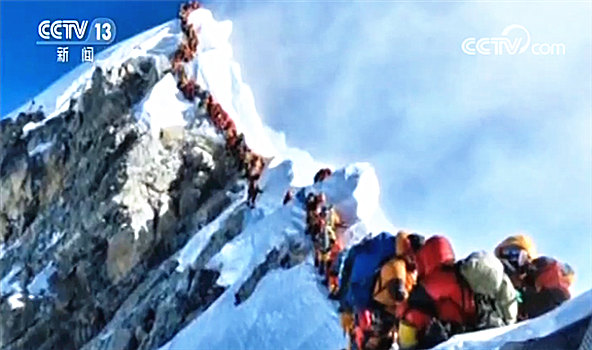
The Nepalese side confirmed on the 27th that Couriss, a 62-year-old American, died suddenly when he returned to a height of about 6,000 meters after successfully climbing Mount Everest. This is the 11th climber who died while climbing Mount Everest this year.
In about a week, 11 climbers died. According to statistics from Nepal, 381 climbers have been allowed to climb Mount Everest this year. One of the climbers said that he was seriously short of oxygen because of too many people and too long waiting time, so he gave up the summit.
A senior climber who has reached the top of Mount Everest said that in previous years, the climbing window period of Mount Everest was about one week, but this year, due to the weather, the best climbing window period was only two days. Therefore, all mountaineering teams hope to complete the "topping" in these two days. Therefore, congestion occurs above 8000 meters above sea level, and the cumulative waiting time exceeds three hours. The oxygen content above 8000 meters above sea level is only 30% of that of the flat land, which is called the "dead zone".
Therefore, some climbers believe that it is essential to limit the number of climbers and check the physical condition and qualifications of climbers.
However, the Nepalese side believes that "too many climbers" is not the cause of the death of climbers. It is likely that altitude sickness leads to disease death, which is unpredictable.
Overwhelmed! Ten tons of garbage were cleared from the south slope of Mount Everest.
There are too many people climbing Mount Everest recently, and the "dead zone" with a height of 8,000 meters actually appears "congestion", and the top of the world is "full of rubbish". On the 27th local time, the Nepalese government dispatched helicopters to deal with the garbage left by people on the south slope of Mount Everest.
On the 27th, the Nepalese government dispatched military helicopters and began to clean up the garbage in the base camp of Mount Everest. The Nepalese government said that their search sites ranged from the base camp at an altitude of more than 5 kilometers to the No.4 camp at an altitude of nearly 8,000 meters. They sent a team of 14 people and spent six weeks searching for empty cans, plastic bottles and oxygen bottles, mountaineering tools and so on. These rubbish add up to 10 tons. The Nepalese government said that at present, these rubbish have been sent to Yamashita town and will be sent to Kathmandu, the capital, for recycling.
Nepal has long been committed to dealing with Everest garbage.
In fact, the Nepalese government and local organizations have long been committed to dealing with the garbage brought by Everest climbers. Since 2011, tons of garbage have been recycled from Mount Everest on a regular basis. In 2014, the Nepalese government also set up a "garbage deposit" for climbers. If they can carry 8 kilograms of garbage from the mountain, this deposit will be refunded, otherwise they will be fined.
The top of the world becomes the "highest garbage dump"
According to Agence France-Presse, decades of mountaineering activities have turned Mount Everest into a "garbage dump", including useless tents, empty beverage bottles and even feces. In addition, since records began in 1922, more than 200 climbers have been killed on Mount Everest, most of them buried under glaciers or snow. Due to the global warming and melting glaciers in recent years, the bodies of the victims who were originally buried appeared together with the garbage.