"100 years, China’s core"-Chinese scientists have made new breakthroughs in the field of high-precision detection of magnetic chips
Xinhua News Agency, Beijing, June 29th (Reporter Wu Mengda, Zhao Xu) "One hundred years, China ‘ Core’ ". On the occasion of celebrating the centenary of the Communist Party of China (CPC)’s founding, researchers from Beihang University wrote these words on a nano-magnetic film with five atomic layers. This thickness is equivalent to one hundred thousandth of that of an ordinary printing paper.
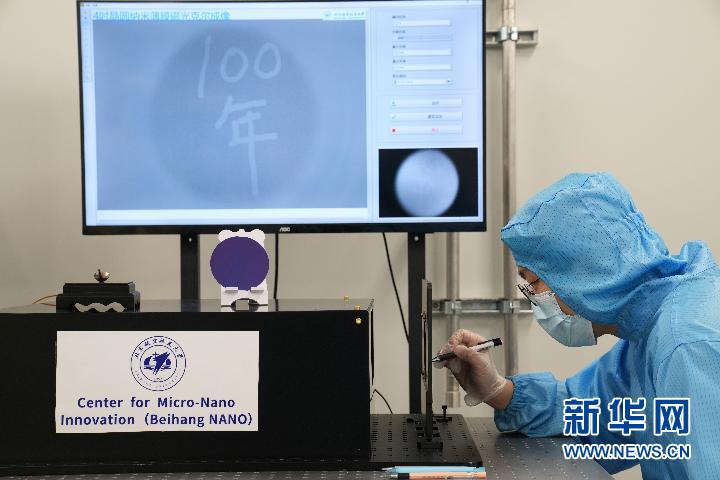
On June 24th, at Beihang University, researchers from the Institute of Integrated Circuits wrote "100 years" on a nano-magnetic film with a thickness of five atomic layers. Xinhua News Agency reporter Yan Huanzong photo
In the production process of magnetic chips, nano-magnetic films need to be evenly spread on the wafer (the substrate used to make silicon semiconductor integrated circuits). How difficult is it to ensure that all wafers are completely "flat"? Zhang Xueying, a teacher in the Department of Technology and Equipment, School of Integrated Circuits, Beihang University, said that it is equivalent to spreading five layers of rice grains evenly on the ground in Haidian District, Beijing, and it must be completely flat. "Therefore, it is particularly important to detect the flatness of the film."
Zhang Xueying introduced that researchers used testing instruments to write on the film through tiny magnetic needles. If the color contrast of the words is consistent and the handwriting is clear, it indicates that the film has good uniformity. After the flatness detection is completed, the nano-film is made into a device and packaged to form a chip.
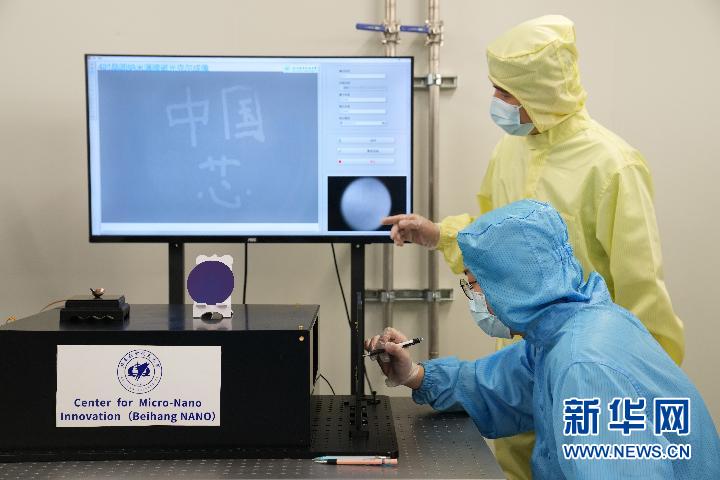
On June 24th, at Beihang University, researchers from the Institute of Integrated Circuits (front) wrote "China Core" on a nano-magnetic film with a thickness of five atomic layers. Xinhua News Agency reporter Yan Huanzong photo
The testing instrument is a wafer-level magneto-optical Kerr tester developed by the research team of Beihang Institute of Integrated Circuits.
Wang Xinhe, director of the Department of Technology and Equipment, School of Integrated Circuits, Beihang University, said that magnetic chips can be used as highly reliable information storage modules and highly sensitive magnetic signal sensing modules, and can be applied to control systems of aircraft and satellites, as well as electronic compasses for mobile phones and automatic driving of automobiles. The key technology of magnetic film detection in the production of magnetic chips belongs to the technology that has been "stuck in the neck" for a long time in China.
"Compared with similar foreign equipment, this instrument has undergone technological innovation in terms of test accuracy and speed, and achieved a breakthrough in independent innovation." Wang Xinhe said.
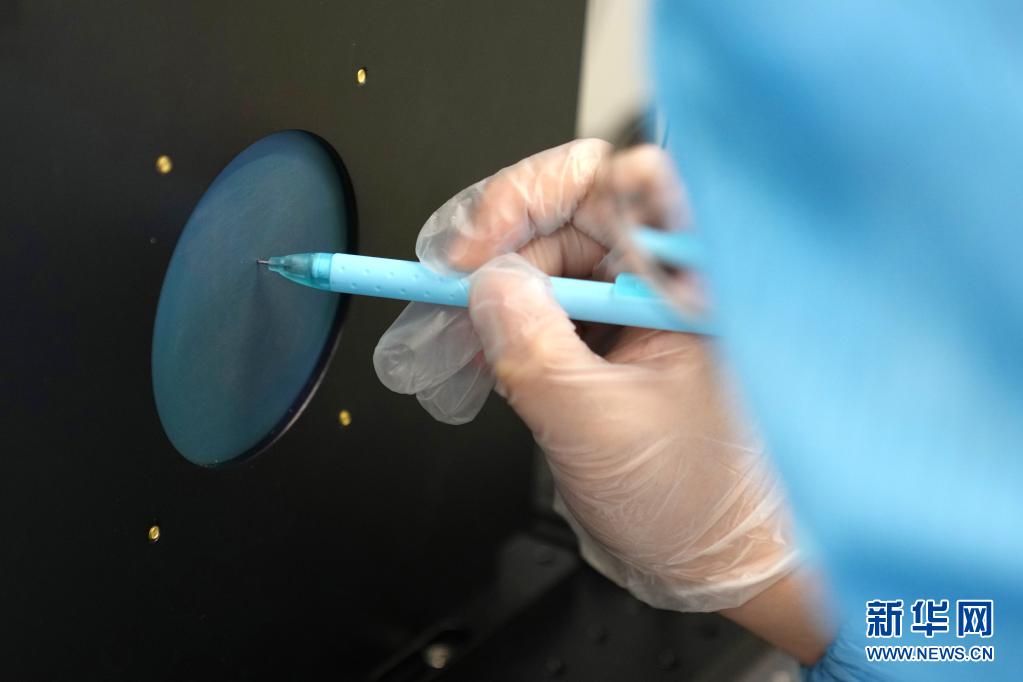
On June 24th, at Beihang University, researchers from the Institute of Integrated Circuits were testing the magnetism of nano-films with a magnetic pen tip. Xinhua News Agency reporter Yan Huanzong photo
It is understood that the instrument has been applied in the field of scientific research and is expected to be put into commercial use in the industrial field in October this year.
As early as 1993, the scientific research team of China Academy of Sciences put the word "China" with 10 atoms, which indicated that China could realize atomic manipulation independently. Today, it is used to write "100 years, China ‘ Core ’ " The wafer-level magneto-optical Kerr tester provides equipment support for the magnetic chip industry with a market scale of 10 billion yuan.
From "China" to "100 years, China ‘ Core ’ " The scientific breakthrough behind it has become a microcosm of the continuous improvement of China’s high-tech independent innovation capability and the continuous enhancement of national scientific and technological strength.
"As a grassroots party member in the front line of scientific research, I feel that solid research and innovation breakthroughs are our best gifts to the founding of the party for a hundred years." Zhang Xueying said.